Introduction:
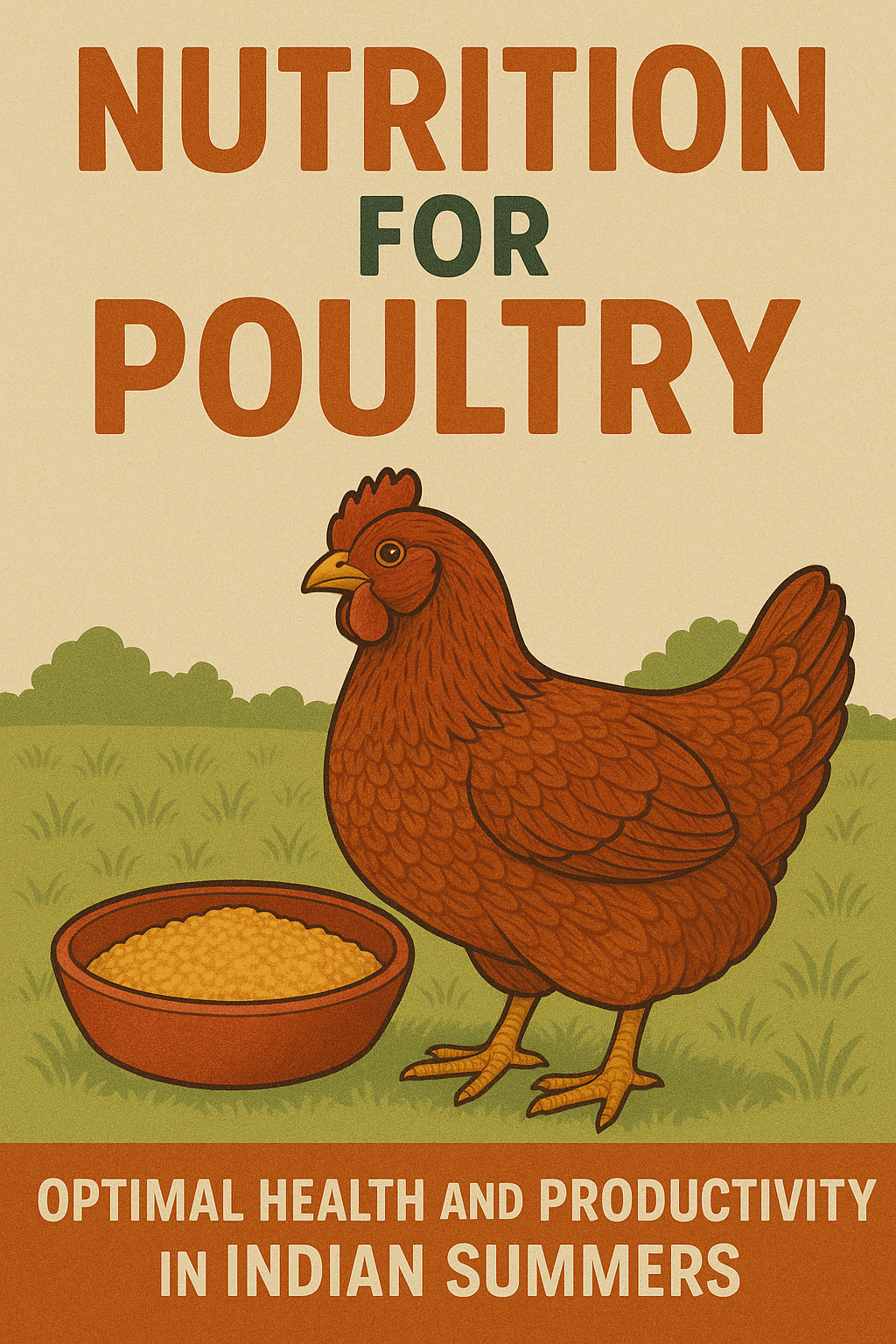
Soaring temperatures combined with high humidity in summers can severely impact bird health, feed intake, growth rates, and overall productivity. Heat stress compromises metabolic functions, suppresses immunity, and increases mortality risk—making nutritional management a frontline defence.
These climatic challenges necessitate tailored nutritional strategies to maximize bird resilience, maintain immune strength, and support growth
Balanced nutrition: Beyond calories and proteins
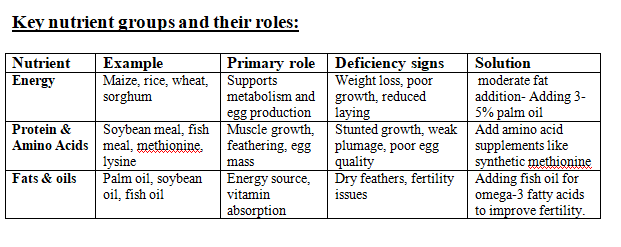
Poultry diets must strike a careful balance between macronutrients (proteins, carbohydrates, fats), micronutrients (vitamins, minerals), and functional additives (probiotics, organic acids).
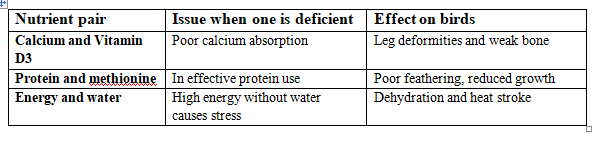
A common approach to streamline this balance is feed integration, but this method can inadvertently reduce vitamin bioavailability, especially heat-sensitive ones like Vitamin A and E.
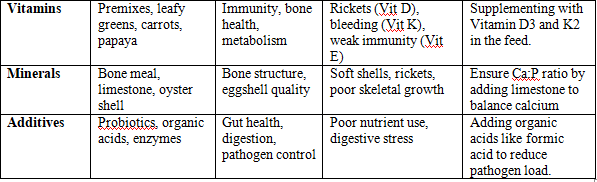
Solution: To counteract this, farmers can incorporate multivitamin supplements—available in both powder and liquid forms—which are readily absorbed and especiallybeneficial during hot weather.
Applying Liebig’s Law: Addressing Limiting Nutrients
Liebig’s law- “the law of the minimum “–
The growth or development of a plant (or any living organism) is limited by the most scarce or deficient essential resource, even if other resources are abundant. This “limiting factor” determines the overall productivity or success of the organism.
For example, Vitamin K2 plays a crucial role in calcium metabolism and blood health, while inadequate Vitamin D absorption is a leading cause of leg deformities in broilers—issues exacerbated during summer when feed intake drops.
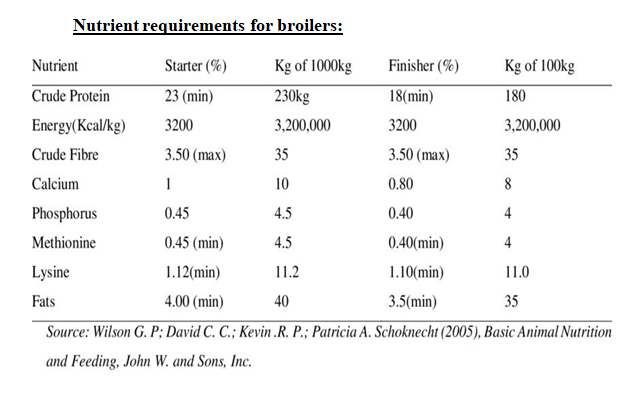
Water: The Most Critical and Overlooked Nutrient
Water is vital for thermoregulation and digestion. In May, water requirements increase dramatically.
- Recommendation: Provide cool, clean water 24/7, ideally 2–2.5 times the feed intake.
- Deficiency Signs: Dehydration, heatstroke, reduced feed intake.
- Solution: Use electrolytes and vitamin C in drinking water to prevent dehydration and oxidative stress.
Environmental Considerations: Heat and Humidity
High ambient temperatures affect nutrient digestibility, feed conversion, and immunity. Proper management can reduce the impact of heat stress:
- Temperature: Maintain housing below 30°C via ventilation and cooling systems.
- Humidity: Prevent wet litter to avoid fungal growth and coccidial outbreaks.
- Lighting: Optimize to avoid adding thermal load while maintaining photoperiod for laying.
Conclusion
In heat-stressed environments, such as during the Indian summer, poultry nutrition must be strategically adjusted. A well-balanced diet with precise supplementation, paired with environmental management, can mitigate stress, maintain performance, and reduce mortality. As veterinarians, we play a crucial role in guiding these evidence-based interventions, ensuring welfare and efficiency in poultry systems.
Writer

Apoorva Rawat1 Dr.Simran jeet Singh
Internship Student
YP-II Department of Veterinary Medicine
College of Veterinary and Animal Sciences, GB Pant University of Agriculture and Technology, Pantnagar, Udham Singh Nagar, Uttarakhand- 263145
Corresponding Author: apoorvar.2024@gmail.com
References:
1.NRC (National Research Council). *Nutrient Requirements of Poultry*, 9th Revised Edition. Washington, DC: National Academies Press; 1994.
2.Mujahid A. *Heat stress in poultry: physiological effects and nutritional strategies to cope with the problem*. World’s Poultry Science Journal. 2011;67(4):653–674. https://doi.org/10.1017/S0043933911000673
3.Sohail MU, Ijaz A, Yousaf M, et al. *Alleviation of heat stress in broilers through betaine and vitamin C supplementation*. Pakistan Vet J. 2010;30(2):85–90.
4.Gous RM, Morris TR. *Nutritional interventions to reduce heat stress in poultry*. World’s Poultry Science Journal. 2005;61(3):447–456.
5.Sayed MAM, Downing J. *Effects of dietary electrolyte balance and addition of electrolyte–vitamin supplements in drinking water on performance, acid–base balance and water retention in heat-stressed broilers*. British Poultry Science. 2015;56(2):195–209.
6.Ravindran V. *Feed formulation for poultry under hot climatic conditions*. Proceedings of the 4th International Poultry Show and Seminar; 2005. Dhaka, Bangladesh.
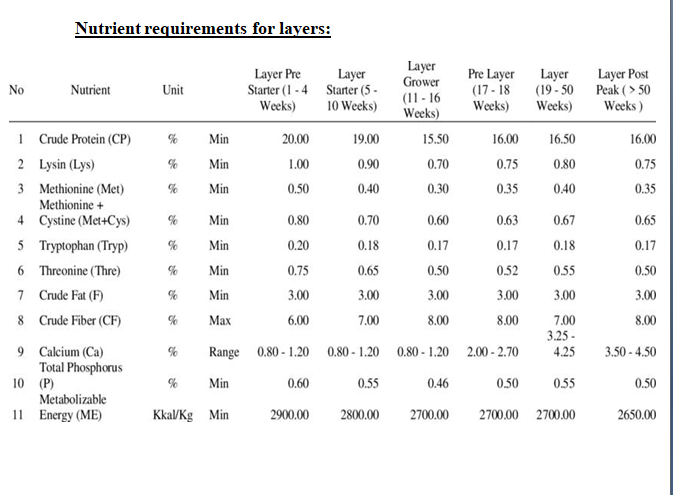
7.Good Parameters for PSO in Optimizing Laying Hen Diet – Scientific Figure on ResearchGate. Available from: [https://www.researchgate.net/figure/Laying-Hens-Nutrient-Requirements_tbl1_326403509](https://www.researchgate.net/figure/Laying-Hens-Nutrient-Requirements_tbl1_326403509)
8.Nutrient Requirements of Broiler Poultry – Scientific Figure on ResearchGate. Available from: [https://www.researchgate.net/figure/NUTRIENT-REQUIREMENTS-OF-BROILER-POULTRY_tbl3_319165268](https://www.researchgate.net/figure/NUTRIENT-REQUIREMENTS-OF-BROILER-POULTRY_tbl3_319165268)