Promoting strong health in dairy calves is fundamental for ensuring their future productivity and welfare on the farm. Calves represent a key investment, and since they are born without a developed immune system, they are particularly susceptible to various diseases. It’s crucial for dairy producers to maintain calves’ well-being and steady growth so they mature into productive, fertile, and healthy adult cows.
Calves face exposure to many pathogens commonly present on dairy farms, which can originate from adult cattle, pets, birds, nearby wildlife, or even humans. Professionals visiting the farm—such as veterinarians, hoof trimmers, nutritionists, and sales personnel—can inadvertently introduce or spread these pathogens. Managing all these risk factors requires dairy farmers to recognize and understand them, as well as to implement effective practices to minimize disease transmission. Biosecurity protocols have been established as a practical set of tools to help farmers mitigate these risks and protect calf health.
Pathogen/Infection transfer
Pathogens can be transferred through multiple routes, which makes managing animal health particularly complex on dairy farms. These routes include contamination from pasture, irrigation water, rodents, wildlife, insects, and even humans, as well as through contact with infected animals, whether healthy or ill. For instance, bacteria like Salmonella may be present in the environment, contaminated water sources, or wildlife such as squirrels and deer; insects can carry viruses like Blue Tongue. The wide diversity of pathogens and their host species underscores the importance of strict hygiene, segregation based on age or lactation stage, and the use of high-quality feed and water to prevent disease transmission.
Research indicates that transmission pathways are complex, involving environmental reservoirs, intermediate hosts, and direct contact with contaminated objects or surfaces. Infections such as Salmonella, Campylobacter, Listeria monocytogenes, and E. coli can enter the farm via contaminated water, feed, or contact with wildlife, and can be spread through fecal-oral routes, inhalation, or direct contact with infected animals. Maintaining strict farm hygiene, appropriate animal separation, and high standards of feed and water quality are fundamental measures to reduce the risk of infection transfer within dairy operations.
Table 1: Overview of major pathogen transfer routes.
| Major Pathogen Transfer Routes a Dairy Farm | |
| From older or sick cattle to calves by direct animal contact or manure contact | Purchasing new cattle with unknown health status nor quarantining (e.g., certificates) |
| Pathogen transfer through feedstuffs | Purchase of semen or embryos |
| Pathogen transfer through drinking water | Rats, mice, insects, foxes, squirrels, birds |
| Wildlife (deer) | Vehicles and people |
General management measures
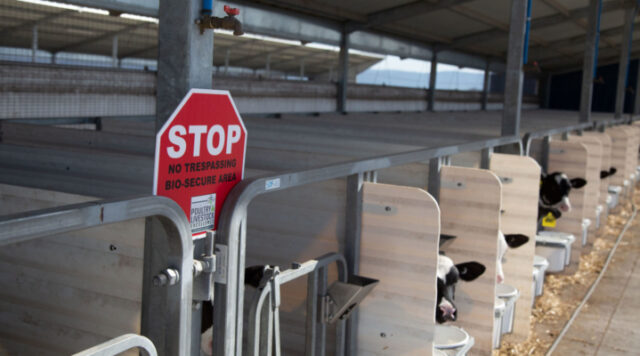
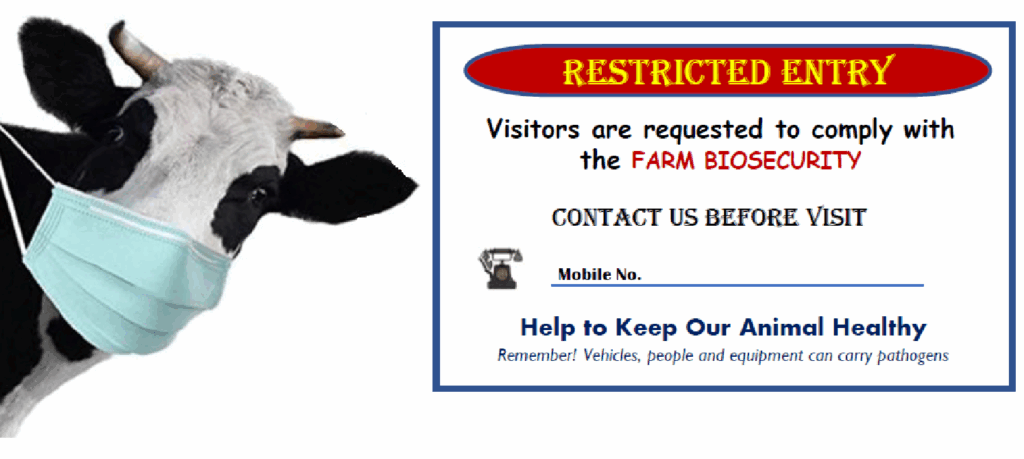
In order to give a foundation to the Biosecurity Protocols it is strongly advised to implement general management measures. These measures assist in adopting the most adequate mentality and attitude on the dairy farm for controlling diseases. Table 2 provides an overview of relevant general management measures. With regard to the third domain in Table 2, it could be envisaged to install large billboards at the farm entrance, pointing the visitors to the rules to comply to when entering that farm. A specifically designated parking place for (professional) visitors should be considered. This too may cut off an infection transfer route.
Table 2: An overview of general management measures.
| Cleanness & Hygiene |
| Identify all things that calves come in contact with and keep these clean Maintain a well-bedded, disinfected maternity pen and calving utensils. After birth, calves should be put into individual calf hutches; the navel disinfected. Bottles, nipples, buckets, tube-feeders must be cleaned and disinfected after use after weaning, calves should be grouped in clean disinfected group pens (5-6 calves). |
| Calf Treatment |
| If calves are to receive injections, be sure that needles are sterile and syringes new. If calves are to be fed by tube-feeder, make sure these are clean, disinfected, dry. |
| People Management |
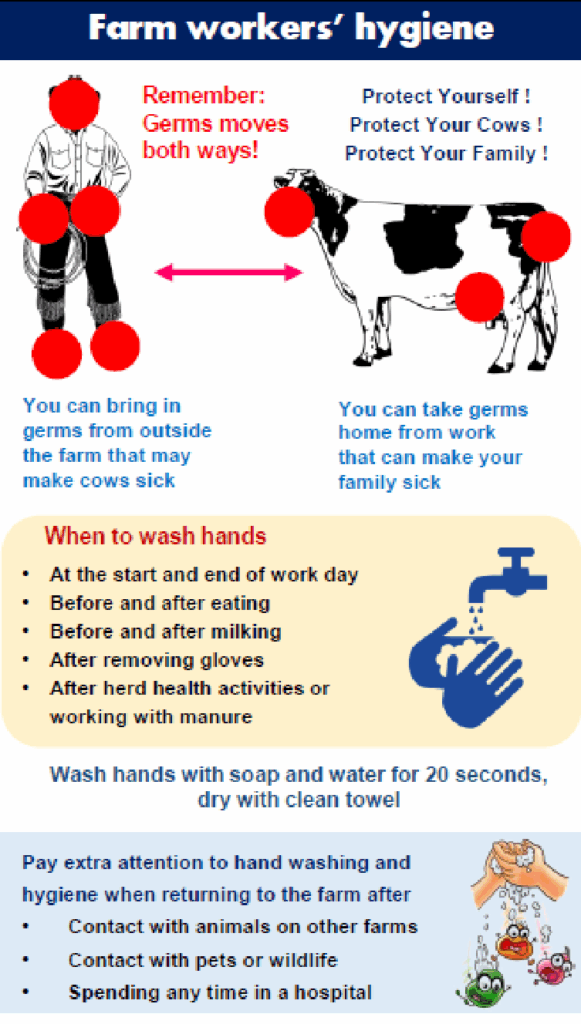
| It is adequate to assign calf feeding, treatment and all handling to specific persons. These persons should apply high hygiene levels to themselves (boots, overall, hands) Professional visitors (vet, nutritionist) should adopt strict hygiene rules of the farm Other professional visitors (feed delivery; cattle truck) should adopt these rules too. All visiting people should disinfect their hands, put on clean boots and overall, when entering the farm, specifically when entering animal barns. |
Biosecurity protocols
A biosecurity program is like an assurance policy for animal health and productivity; in neither of them the zero-risk does exist. Moreover, it is quite common that the implementation of a biosecurity program is less costly than having several diseased animals. Together with the farmer or farm manager, the veterinarian can take the lead in developing a biosecurity program.
Biosecurity programs are based on three pillars:
a) An analysis of the prioritized prevalent and potential threats (infections) and risks.
b) The management of these risks.
c) The communication about the risks (explaining to employees; need of compliance)
Analysis of threats and risks
The farmer and veterinarian discuss about the major threats (infections) present on or expected for the dairy farm. In this context this paper will not elaborate on cheese-making farms for reasons of simplicity. It could be worthwhile to identify first whether the farm produces milk or animals (culled cattle; sold calves) too. Let us assume for simplicity reasons that the farm produces milk only. Then, it should be established which are the most prevalent diseases on the farm needing attention and which other non-prevalent diseases might become a real threat and, hence, should be prioritized too. This yields a short list. An example shortlist may comprise the most important mastitis pathogen (e.g. Staph. aureus) on the farm, combined with Mortellaro disease and BVD. The following step is to determine by which routes these pathogens enter the farm, how they survive and are possibly shed by the animals. Next step is to identify the most relevant risk factors contributing to the occurrence of these diseases and assess their respective impact (minor; moderate; high). When no information on impact is available from literature, the veterinarian can make a qualitative assessment of the risk factor impact. Then the biosecurity program can be further developed.
Developing the biosecurity program
The sound foundation of a biosecurity program is the implementation of “general management measures’’. Foundation because these measures may adjust management attitude and mentality, as well as that of farmworkers. As addressed before, the biosecurity program is further based on the analysis of threats (hazards or diseases) and their associated risk factors. This analysis results in the definition of ‘’critical management points’’. Examples of such Critical Management Points (CMP) are presented in Table 3. CMP should be adapted for the individual farm regarding applicability and ease of understanding. Limiting the animal movements onto and within the farm, as well as limiting possible contacts between animals on one side and vehicles/vectors/people on the other side represent important control measures in biosecurity. Separation of cattle in different management groups, such as fresh cows, mid-lactation, end-lactation, dry cows, but also in calf-age groups means that each group is an epidemiological management unit. Contacts between groups must be avoided. Management should be adapted to the specificities of each group individually. Epidemiologically spoken, it is not necessary to control all risk factors for a disease. Given the commonly multifactorial nature of diseases in ruminants, it is sufficient to eliminate or reduce the impact of several relevant risk factors to get rid of a disease.
Table 3: An example of Critical Management Points (CMP) on a dairy farm.
| Exposure Area | Example | CMP |
| New additions to the herd | Cows, calves, embryos, semen | Certificates of Health and Origin. Clinical inspection of animals. Diagnostic testing for given pathogen(s). Quarantine for new cattle. |
| Feed & Water | Forages, water, concentrates, milk replacer | Water microbiological quality testing. Preventive measures on water sources. GMP certificates for concentrates. Milk replacer from a certified company. |
| Animal contacts | Neighboring cattle, cattle returning from show, clinics, wildlife | All contacts must be minimized. Returning cattle are to be considered as ‘’new additions’’ (see above). Calves should be separated in age-groups. |
| Vectors & Vehicles | Rodents, truck/lorry, tractors, people | Implement a rodent control program. Trucks/lorries to be disinfected at farm entrance. Strict hygiene instruction for people (on farm or visitors). Male calves sold for fattening should leave the farm from a sole designated area. |
| Health management | Apply a Good Drug Administration Code of practice. If indicated, give short trainings (e.g. injection techniques). Keep records of disease and treatment in calves. |
GMP = produced under a good manufacturing code of practice.
Prevention
With regard to prevention, Noordhuizen [4] presents a listing of 93 management measures contributing to prevention of occurrence of infectious diseases. These measures can be regarded as being an essential part of a Good Dairy Farming Code of Practice. Most of the measures are well-known but now compiled into one practical document. Examples of measures are the routine monthly scoring of body condition in dry cows and fresh cows; the recalculation of feed rations for calves at each feed change; checking growth rate in older calves at least twice yearly; checking housing hygiene weekly; checking barn climatic conditions daily.
When a calf is removed from a hutch: put the hutch outside in a designated cleaning area.
- 1. Remove straw, manure and dirt.
- 2. Clean it with high pressure water.
- 3. Disinfect, rinse and let the hutch dry in the air.
When young calves are being fed, they should be checked routinely on clinical signs of illness; findings should be noted on a scoring card. Severely affected calves should be separated from group mates and put in a separate sick-pen. Treatment should be recorded and follow a Calf Treatment Advisory Plan, designed by the veterinarian. The veterinarian may draw Checklists for the individual dairy farm, which may assist the farmer in his awareness of risks on his farm. Table 4 presents a self-assessment farmer’s checklist for assessing the risk level for Infectious Bovine Respiratory disease (IBR, BHV-1). For young calves particular checklists can also be developed. A short example is given in Table 5. One may deduce from this Table 5 that the better the hygiene and the better the management quality, the lesser the calves will be at risk of diseases such as respiratory disease or diarrhea.
Table 4: Anternal farmer’s checklist for assessing the risk of IBR on a dairy farm.
| Yes | No | N-A | Your Answer to the Topic Named |
| You purchase cattle from non-IBR-free-certified farms | |||
| You voluntarily put cattle from forenamed farms in pasture and or in barns | |||
| You participate in cattle shows where non-IBR-free cattle is potentially present | |||
| You graze your calves and maiden heifers next to pastures where cattle from other farms graze | |||
| Your cattle sometimes escape from their pasture and make contact with cattle from other farms | |||
| Neighboring cattle sometimes escape and make contact with your cattle | |||
| You use sometimes semen from non-EU-certified sources | |||
| You let professional visitors enter your farm without complying to hygiene rules set (boots, gloves, overall) | |||
| You purchase cattle from non-IBR-free-certified farms | |||
| You voluntarily put cattle from forenamed farms in pasture and or in barns | |||
| You participate in cattle shows where non-IBR-free cattle is potentially present | |||
| You graze your calves and maiden heifers next to pastures where cattle from other farms graze | |||
| Your cattle sometimes escape from their pasture and make contact with cattle from other farms | |||
| Neighboring cattle sometimes escape and make contact with your cattle | |||
| You use sometimes semen from non-EU-certified sources | |||
| You let professional visitors enter your farm without complying to hygiene rules set (boots, gloves, overall) | |||
N-A means not applicable.
Table 5: Part of a Checklist for scoring management practices in young calf rearing.
| Farming Area | Best Management | Moderate Management | Poor Management |
| Birth management Navel disinfection 7% Calf rubbed dry Calf housed Cleaning & disinfection | Yes Yes In hutch Yes | — — With its dam — | No No In straw pen No |
| Colostrum period 1 1st colostrum within 2h Quantity 1st colostrum Colostrum quality 1st colostrum for 2nd meal 2nd meal max 8 h after 1st | Yes 1½ – 2½ L Serum IgG >2000 mg/L Yes Yes | No —Serum IgG 1000-2000 mg/L — __ | No No Serum IgG < 1000 mg/L No No |
| Colostrum period 2 1st colostrum in freezer too Colostrum intake/day/calf Colostrum meals/day/calf Colostrum hygiene | YesYes 4-6 L 3 Good | No– — 2 Moderate | NoNo < 4 L or > 6 L Unlimited Poor |
Conclusion
The changes to be made on a dairy farm in the context of a biosecurity program do, in general, not require large investments while the benefits of improvement are high. The appropriate, successful implementation of such a program depends on the proper understanding of the relevance and the benefits produced, as well as on the compliance. The herd veterinarian also plays a role in the communication process on the farm. When deemed necessary, a short hands-on training sessions for specific issues within the program for specific farmworkers can be developed.
A biosecurity program is not a panacea, functional on all farms at the same time; moreover, it must be tailor-made for each individual farm. This is the only way in which costs and benefits can be assessed in a reasonable manner. Finally, it can be stated that a biosecurity program can most easily be an extension of an on-going herd health and productivity management program on the dairy farm, mainly because several issues addressed in the forenamed above are also part of these herd health and productivity management programs. The difference might be in the organization and structuring of biosecurity actions, management measures and checklists in protocols.
1Manoj Kumar Singh, 2Jinu Manoj, 3Ahmad Fahim, 4Amit Kumar, 5D.K. Singh
and 6Alka and 7Tanya
1,3Assistant Professor,4,5Professor, 6,7M.V.Sc. Scholar, Department of Livestock Production Management, COVAS, SVPUAT, Meerut, U.P
2DIO, Department of VPHE, LUVAS, Hisar, Haryana