Abstract
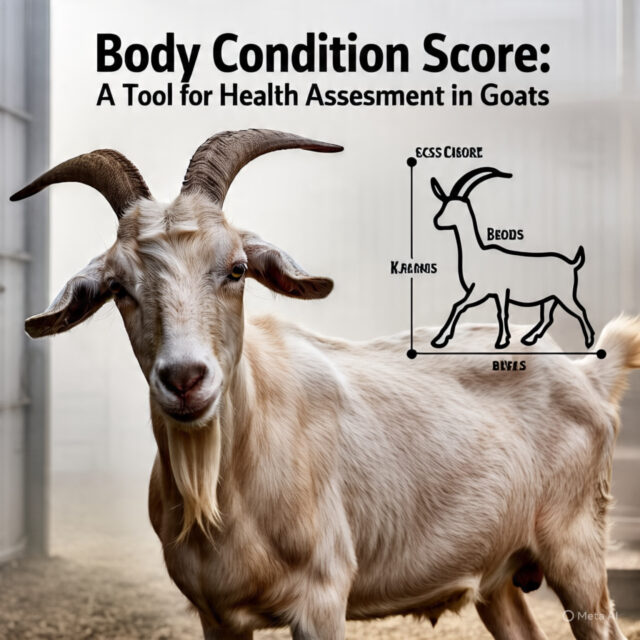
Body Condition Score (BCS) is a simple method used to check the health and well-being of dairy goats. It shows how much fat and muscle the goat has, helping farmers know if their goats are being fed properly. By looking at the BCS, farmers can tell if the goats are getting enough nutrition and if there might be any health concerns. The score goes from 1 to 5.
- A score of 1 means the goat is very thin and may not be getting enough food.
- A score of 5 means the goat is overweight, which can also cause health problems.
By checking BCS regularly, farmers can adjust their feeding practices and catch any health problems early.
Introduction
The Body Condition Score (BCS) is a way to estimate how much muscle and fat a goat has. It’s a better way to assess a goat’s health than just looking at its weight. BCS is based on how the goat looks, so it doesn’t require special equipment or tests. Anyone who knows the method can quickly check a goat’s condition. BCS helps goat owners evaluate their goats’ nutrition and can improve how efficiently their herd produces milk and offspring.It’s important to check the body condition of goats before breeding, during pregnancy, after giving birth, at weaning, and before selling. Goats in poor condition may have trouble getting pregnant, producing enough milk, or giving birth to healthy kids. This can lower both milk production and profits. Goats in good condition have enough energy and fat to perform well, but not too much fat, which can also cause problems. For example, goats that are too fat when they give birth might have health issues, and thin goats in early lactation may not have enough energy to produce enough milk. Thin goats at breeding might also struggle to get pregnant.
How to perform
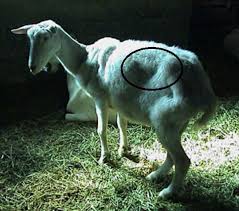
The Body Condition Score is determined on a scale of 1.0 to 5.0 with increments of 0.5. A score of 2.0 to 3.5 is considered healthy for sheep and goats. It is important that goats are neither too fat nor too thin. An animal with a BCS lower than 2.0 may be facing a health or management problem while a score of 4.5 and higher are rarely seen in a normal management situation. Assigning a BCS requires one to physically feel the animal. With practice, it is possible to accurately evaluate a goat’s BCS in about 10-15 seconds. To determine the BCS, the handler uses his/her hands to feel for the fullness of muscle and fat cover in the loin, sternum and rib cage regions.
Regions for evaluation of body condition in goats
1. Lumbar region:The lumbar region is formed by lumbar vertebrae which is located immediately behind the last rib and before the hip bones and covered by loin muscle. Amount of fat and muscle present over and around the vertebrae is used as a criterion for determination of BCS. Lumbar vertebrae have two protrusions, the vertical protrusion called the dorsal spinous process and the two horizontal protrusions called the transverse process. One should run their hand over this area and try to grasp these processes with your fingertips and hand. The degree of sharpness or roundness of the lumbar vertebrae is assessed and used to assign BCS.
2. Rib cage:The area formed by thirteen pairs of ribs and intercostals muscles. The fat cover on the ribs and intercostal (between ribs) spaces is used for identification of BCS. Touch this area and determine if one can feel each of the ribs.
3. Sternum:The sternum is the third part to assess. In goats it is an important area to assess. The fat cover over the sternum (breast bone) can be pinched and is used for BCS determination in goats.
Scoring of Goat
BCS-1
The goat looks emaciated (very thin) and weak. The spinous process and transverse processes of lumbar region are prominent and sharp and clearly visible. The fingers pass easily under the ends of transverse process which can be easily felt. The backbone is highly visible, hollow flank and clearly visible ribs. The ribs are not covered with fat and intercostals spaces can be felt easily by fingers. Sternal fat easily grasped between thumb and fingers and moved from side to side.
BCS-2
Slightly better than BCS-1 but the goat looks thin. The spinous processes of lumbar vertebrae feel prominent but smooth and individual process can be felt. The transverse processes are smooth and rounded and with a little pressure one can pass the fingers under the ends. Backbone is visible with a continuous ridge and ribs can be seen and felt. Only a small amount of fat cover present over inert costal spaces of ribs. Sternal fat wider and thicker than BCS 1, but can still be grasped and lifted.
BCS- 3
The goat looks moderate or normal. In lumbar region the spinous processes are detached only as small elevations, the processes are rounded and smooth and individual process can be felt only by giving pressure. The transverse processes are smooth and well covered. Firm pressure is required to feel over the ends of transverse processes. Backbone is not prominent. Ribs are covered with even layer of fat. Vertebrae are cover by thick tissue layer. Sternal fat is wide and thick. It can be grasped, but has very little movement.
BCS- 4
The goat appears fatty. The spinous processes of lumbar vertebrae can be detected by pressure as a hard line between the fat covered back. The ends of the transverse processes of lumbar vertebrae cannot be felt. The backbone and ribs cannot be seen. Sternal fat difficult to grip and cannot be moved from side to side.
BCS- 5
The goat gives very fatty appearance. The spinous processes cannot be detected even after firm pressure and there is a depression between the layers of fat in the position where the spinopus processes would normally be felt. The transverse processes cannot be detected. There may be heavy deposition of fat around rump and tail areas. Backbone is buried in fat. Ribs are covered with excessive fat and not visible. Sternal fat extends and covers sternum, and cannot be grasped.
Ideal ranges of BCS for various physiological states:
- In healthy physiological stage the BCS ranges between 2.5 to 3.5 but if it ranges 1.0 or 1.5 to 2.0 it has management of health problem.
- In breeding buck, ideal BCS is ranges between 3.0-3.5. The bucks having BCS score less than 2 to 2.5 will not have sufficient stamina and vigor to breed. They should have 3.0 score before star the breeding season. The bucks with BCS> 4 lack sexual desire.
- At the time of mating does should have a score of 3 for optimum result with a range of 2 to 3 being acceptable (Koyuncu and Altınçekiç, 2013).
- In Pregnant doe, ideal BCS ranges between 3.0-3.5. BCS more than 3.5 leads to pregnancy toxaemia/ ketosis, retention of placenta, fatty liver, abnormal displacement and dystokia. BCS < 2 to 2.5 leads to poor kid survivability and milk production.
- During kidding ideal BCS ranges between 3.0-3.5 to ensure the adequate production of colostrum and reservoir to support high milk production especially in early lactation.
- In lactating doe BCS should be 2.5-3.0. it should not come below 2 .0 to 2.5. Quick drop of BCS during lactation leads to anoestrus, anovulatoryoestrous, shorter oestrous, repeat breeding and infertility. During flushing there is no need of flushing if BCS is 3.5 or more. The goats will response to flushing treatment if BCS is 2.0 or less.
Conclusion
Goat Body Condition Score (BCS) is a method used to measure the amount of body fat and nutritional status of goats. Through a comprehensive score, it accurately reflects the body condition of dairy goats, which is an important indicator for evaluating herd productivity. It is simple to use and can help producers make management decisions about feeding to ensure reproductive performance and reduce costs. Moreover, it is also useful in goat marketing.
Mamta Meel1, Amit2, Balram Yadav3
College of Veterinary and animal sciences, Navania, Udaipur, Rajasthan